
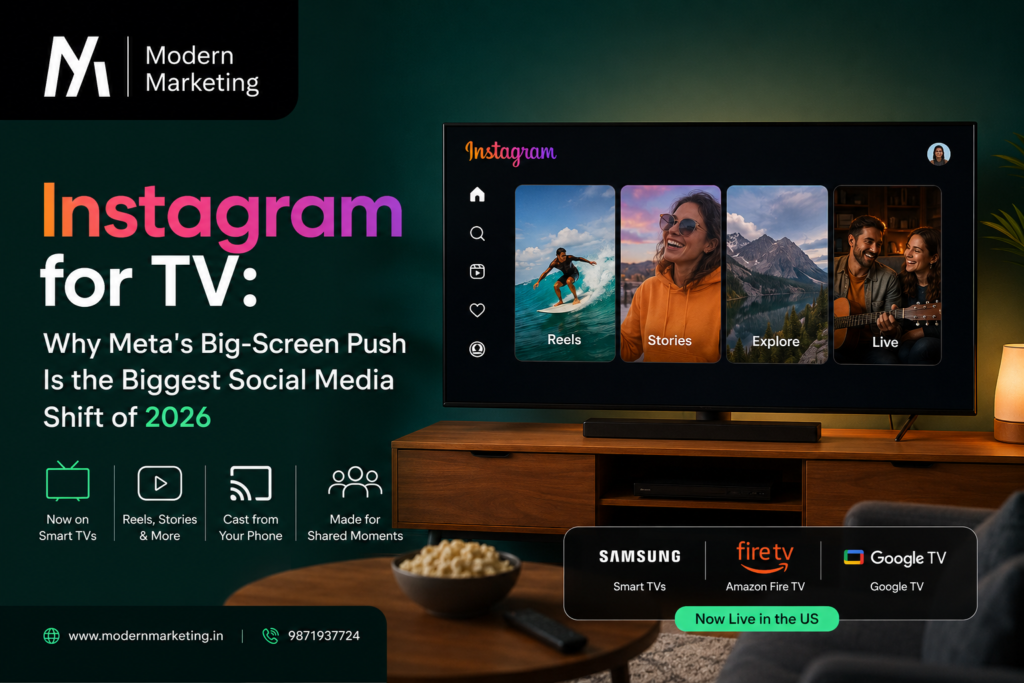
If you’ve noticed Instagram suddenly showing up on your Samsung Smart TV, you’re not imagining it. Instagram for TV is Meta’s newest, boldest move yet – and it changes how brands, creators, and marketers need to think about video content in 2026. As of June 22, 2026, Instagram for TV is officially live on Samsung Smart TVs across the US, joining Amazon Fire TV and Google TV in what Meta calls a push to make Reels a “shared, living-room activity.” At Modern Marketing, we track shifts like this closely because they directly affect how we build SMM, SEO, and content strategies for our clients – and this one is big enough that you need to understand it now, not in six months.
This isn’t a small feature update. It’s Meta repositioning Instagram from a “phone app you scroll” into a video destination that competes directly with Netflix, YouTube, and Amazon Prime Video for your living room. Below, we break down exactly what’s happening, why it matters, and what it means for your brand.
What Is Instagram for TV?
Instagram for TV is a dedicated television app version of Instagram that brings Reels, Stories, and (soon) longer-form video content to smart TV screens instead of just mobile phones. It’s not simply Instagram stretched onto a bigger display – Meta has built TV-specific features including interest-based content channels, phone-to-TV casting, and a dedicated hub for horizontal (widescreen) video, since vertical Reels look awkward with black bars on a 55-inch screen.
When Did Instagram for TV Launch, and Where Is It Available?
Instagram for TV didn’t appear overnight – it’s been a deliberate, year-long rollout:
- December 16, 2025 – Testing began on Amazon Fire TV devices
- February 24, 2026 – Expanded to Google TV devices
- June 22, 2026 – Expanded to Samsung Smart TVs (2020 models and newer)
With Samsung on board, Meta now has a presence across the three biggest connected-TV ecosystems in the US, covering the vast majority of smart TVs already sitting in American living rooms.
Why Is Meta Doing This Now?
Three numbers explain it:
- CTV ad spending is exploding. US connected-TV (CTV) ad spending is projected to hit roughly $38 billion in 2026 – and for the first time, CTV upfront ad commitments ($17.73 billion) are set to overtake traditional primetime linear TV commitments ($16.98 billion).
- YouTube is already winning the living room. YouTube captured the single largest share of all US TV viewing of any media company Nielsen measures – territory Instagram is now openly chasing.
- Streaming has already overtaken broadcast. For the first time, the number of people watching TV through streaming services has surpassed those watching via broadcast and cable.
In short: the living room is where ad dollars and attention are both moving, and Meta doesn’t want to be left out.
Is This Just IGTV All Over Again?
No – and Meta seems to know it. Instagram already tried (and failed) at long-form video once before. IGTV launched in 2018 and shut down in 2022 because it asked users to leave their main feed and open an entirely separate app – too much friction, not enough payoff.
This time, the strategy is reversed. Instead of pulling users into a new app, Meta is pushing Instagram’s existing content onto a screen people already use for relaxed, long-session viewing: the TV. That’s a fundamentally different (and smarter) approach to solving the same problem.
What New Features Is Instagram for TV Adding?
Meta has confirmed the following features are live or in active testing:
- Phone-to-TV casting – send Reels straight from your phone to your television
- Interest-based channels – browse content by topic (comedy, sports, favorite creators) instead of one endless feed
- Stories on the big screen – Stories, previously mobile-only, now appear in the TV app
- Horizontal video hub – a dedicated space for widescreen video built for TV, not vertical Reels
- Episodic series – multi-part, serialized content designed for repeat viewing (tied to Instagram’s new “Series” feature for Reels)
- Live creator broadcasts – TV-style live programming from creators
Does This Mean Instagram Videos Will Get Longer?
Yes – this is the core shift. Instagram has confirmed it’s testing longer-form videos, multi-episode series, and live TV-style content, a clear departure from the short, fast Reels format that built the platform’s video strategy over the past few years. Instagram’s VP of Product, Tessa Lyons, has said the goal is to help creators reach audiences in new formats – not replace Reels, but expand beyond them.
How Does This Affect Creators?
This is a genuine opportunity if you create content:
- New ad inventory and monetization paths open up as TV-native formats roll out
- Episodic/serialized content rewards consistency – creators who post recurring, themed content are positioned to build appointment-viewing audiences, much like a TV show
- Longer-form content gets more breathing room – ideas that don’t fit into 30-90 second Reels finally have a home on the same platform
What Does This Mean for Brands and Marketers?
This is where it gets practical for businesses working with an agency like Modern Marketing:
- Start creating horizontal, TV-friendly video – not just vertical Reels. If your brand only produces 9:16 content, you’re not ready for where Instagram is heading.
- Think in episodes, not just one-off posts. Serialized content (a recurring series, weekly format, or themed mini-show) is positioned to perform better as Instagram leans into TV-style consumption.
- Plan for shared, group viewing – not just solo scrolling. Content watched on a TV with family or friends in the room has a different tone and pacing than content watched alone on a phone during a commute.
- Expect new ad formats tied to CTV. Meta has reportedly been in talks with supply-side platforms like Magnite and Comcast about scaling its advertising into CTV – meaning new placement opportunities (and new competition for ad space) are coming.
Who Is Instagram Really Competing with Now?
With this move, Instagram is no longer just fighting TikTok and YouTube for short-form attention. It’s now stepping directly into the territory of Netflix, Amazon Prime Video, and traditional broadcast TV – competing for the hours people spend relaxing in front of the biggest screen in the house, not just the few seconds they spend scrolling on a commute.
Is This Available Outside the US?
Not yet. As of now, Instagram for TV – across Samsung, Amazon Fire TV, and Google TV – is US-only. Meta has indicated plans to expand to more devices and countries over time, but no international timeline has been confirmed.
Key Takeaway
Instagram for TV signals a real strategic pivot: Meta is betting that the next big battleground for attention (and ad revenue) isn’t your phone – it’s your living room. For brands, this is an early-mover opportunity. The businesses that start building TV-friendly, episodic, longer-form video content now will have a head start when this becomes the new normal – much like the brands that took Reels seriously early outperformed the ones that waited.
Frequently Asked Questions
Instagram for TV is Meta’s dedicated television app version of Instagram, bringing Reels, Stories, and new TV-only features like horizontal video and interest-based channels to smart TV screens instead of just mobile phones.
Instagram for TV expanded to Samsung Smart TVs (2020 models and newer) in the US on June 22, 2026, joining its existing availability on Amazon Fire TV and Google TV.
No. IGTV (2018-2022) failed because it forced users into a separate app. Instagram for TV instead brings existing Instagram content directly onto smart TVs people already use, without requiring a new destination app.
Yes. Instagram is actively testing longer-form videos, multi-episode series, and live creator broadcasts alongside its existing short-form Reels, specifically for the TV format.
Not yet. As of now, Instagram for TV is US-only across Samsung, Amazon Fire TV, and Google TV, though Meta has indicated plans to expand internationally over time.
Need Help Adapting Your Content Strategy for Instagram’s TV Push?
At Modern Marketing, we help brands stay ahead of exactly these kinds of platform shifts. From SMM and SMO to SEO, SEM, and web development, our team builds complete digital marketing strategies that evolve as fast as the platforms do. If you want your brand’s content ready for the next era of Instagram – on phones and TVs – get in touch with our team today.